
Selecting a whiteboard for a Singapore home office, corporate meeting room, or classroom often presents a frustrating dilemma: a budget-friendly board might look pristine initially, but within a few months of active use, it can become permanently stained with grey shadows and stubborn ink residue. To avoid this common pitfall, it is crucial to understand that glass whiteboards offer the longest physical lifespan and the highest resistance to ghosting, closely followed by porcelain (enamel-on-steel), while melamine boards serve as a highly economical but significantly less durable option. By evaluating how these materials are made, how they wear over time, and what maintenance they require, you can make an informed investment that matches your writing frequency and budget.
How do melamine, porcelain, and glass whiteboard surfaces differ in construction?
Melamine, porcelain, and glass whiteboards differ fundamentally in their core materials and surface coatings, which directly dictates their durability.
Melamine boards are constructed by applying a thin layer of plastic resin over a substrate core, typically made of medium-density fibreboard (MDF) or particleboard. This resin coating creates a smooth, lightweight writing surface, but because it is organic and relatively soft, it remains inherently porous at a microscopic level. Over time, the protective resin layer naturally wears down under the friction of dry felt erasers and marker tips, exposing the highly absorbent wood-fibre core beneath.
Products mentioned in this guide
123 Lazada user ratings
Convenient size options, Flexible mounting options, Great for educational purposes, Durable and practical, Flexible mounting options, Great …Read full reviewShow less
Convenient size options, Flexible mounting options, Great for educational purposes, Durable and practical, Flexible mounting options, Great for educational purposes, Great for educational purposes,
Great for educational purposes,
Durable and practical,
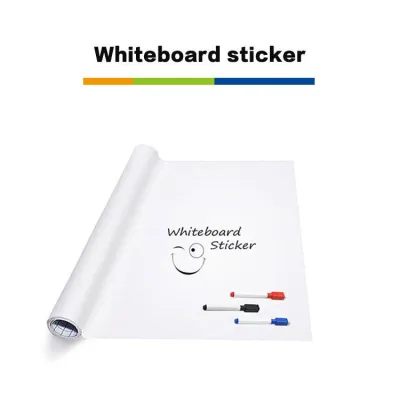
238 Lazada user ratings
not used yet, will edit review once used. delivery took a little while but is ok.
received, not used yet but quality looks good! thank you seller
All good easy to stick and use
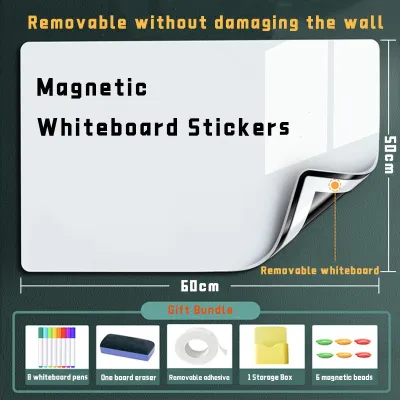
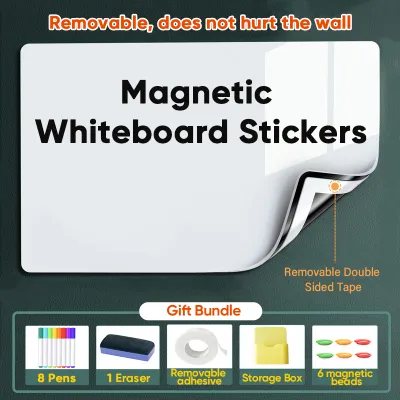
6 Lazada user ratings
item received in good condition with fast delivery. . come with double side tape. good quality. highly recommended.
Material is very thin, very bad after installation... highly not recommended, very disappointed.
didn't include the double sided tape as advertised (probably forgot), otherwise it's quite ok
55 Lazada user ratings
fast shipping by seller. horrible delivery by tracx (formerly qxpress) - left parcel outside without notifying or consent. whiteboard is not…Read full reviewShow less
fast shipping by seller. horrible delivery by tracx (formerly qxpress) - left parcel outside without notifying or consent. whiteboard is not really magnetic. need to stick on metal surface first for the duster, holder, etc to stick.
Ease of Use:ok Durability:ok Portability:ok item is well received and packing is good. have replace my old Whiteboard with this. Great and m…Read full reviewShow less
Ease of Use:ok Durability:ok Portability:ok item is well received and packing is good. have replace my old Whiteboard with this. Great and my kid love it as it like a new one. value for money and east to change.
Sticks nicely on the wall. Good as a white board. Magnetic feature is not very strong though, but can hold lighter weight items. On the whol…Read full reviewShow less
Sticks nicely on the wall. Good as a white board. Magnetic feature is not very strong though, but can hold lighter weight items. On the whole, good product.
Packed well, strong and durable, super easy to put on. Great price as others of the same quality can be very expensive
Nice board, way to stick and re-stick too..
Prices are valid at publication and may change. Please refer to the product page for the latest price.
Porcelain whiteboards, often referred to as enamel-on-steel boards, feature a much more robust multi-layered construction. During manufacturing, a ceramic glaze is fired onto a heavy-duty steel backing plate at temperatures typically exceeding 800 degrees Celsius. This intense thermal process fuses the ceramic glass-like enamel directly to the steel, creating an incredibly hard, dense, and non-porous surface. The steel backing not only provides exceptional structural rigidity but also makes the board naturally magnetic.
Glass whiteboards represent the premium tier of visual display boards, constructed from tempered safety glass that is usually 4mm to 6mm thick. Tempered glass undergoes specialized thermal or chemical treatments to increase its strength, ensuring that it resists heavy impacts and, in the rare event of breakage, crumbles into small, blunt fragments rather than sharp shards. The back of the glass sheet is finished with an opaque paint or foil layer to provide the necessary visual contrast for dry-erase markers. Because glass is completely non-porous and chemically inert, the writing surface itself is entirely impervious to ink penetration.
Which whiteboard material offers the longest lifespan and best ghosting resistance?
Tempered glass whiteboards offer the longest lifespan—often lasting decades—and the highest resistance to ghosting because their surface is completely non-porous.

Ghosting occurs when the solvents and pigments in dry-erase ink penetrate the microscopic pores of a whiteboard surface, leaving behind a permanent, faint shadow of previous writing. Because melamine is a porous plastic resin, it is highly susceptible to ghosting; as the surface is wiped repeatedly, the friction creates micro-scratches that trap ink pigments. In contrast, porcelain and tempered glass surfaces are completely non-porous, meaning dry-erase ink sits entirely on top of the material without ever sinking in, allowing it to be wiped away cleanly even after weeks of remaining on the board.
Physical wear and scratch resistance also vary dramatically among these three materials. Melamine is highly vulnerable to physical damage; accidental scratches from keys, rings, or abrasive cleaning tools will permanently ruin the writing surface. Porcelain is exceptionally scratch-resistant due to its fired ceramic coating, making it highly suitable for high-traffic environments where physical contact is frequent. Glass is virtually scratch-proof under normal office and classroom conditions, resisting scratches from metal objects and maintaining its pristine, smooth finish indefinitely.
The expected lifespan of each board depends heavily on usage frequency. In a heavy-use environment, such as a daily university lecture hall or a busy corporate agile planning room, a melamine board may begin to ghost and degrade within 1 to 3 years. A porcelain board in the same high-traffic setting can easily last 10 to 20 years without significant loss of erasability. A tempered glass board, barring catastrophic physical impact, has an virtually unlimited lifespan and can easily last the lifetime of the building. For light-use scenarios, such as a home office where the board is written on once or twice a week, a melamine board can perform adequately for 5 years or more if properly maintained.
When shopping, buyers should carefully verify manufacturer specifications and product labels rather than relying on generic marketing claims. Look for explicit “ghost-free” guarantees, surface hardness ratings (such as the Mohs scale or pencil hardness standards), and the duration of the manufacturer’s warranty. High-quality porcelain boards often carry a 20-year or lifetime surface warranty, while premium glass boards almost universally feature lifetime guarantees against staining and ghosting. Melamine boards, conversely, rarely offer warranties extending beyond 1 to 5 years, reflecting their limited long-term durability.
Erasability, drying speed, and writing smoothness are also highly dependent on the specific marker and surface combination. To verify the performance of a new board, perform a simple spot test: write a small mark with a standard dry-erase marker, let it dry completely for 60 seconds, and check if it wipes away cleanly with a dry felt eraser without leaving a shadow. If the ink smears or leaves a faint grey stain during this initial trial, the surface or marker chemistry may not be compatible, or the board may require a specialized low-odor dry-erase marker formulation.
How does the upfront cost of each whiteboard compare to its long-term value?
While melamine whiteboards require the lowest upfront investment, glass and porcelain boards provide significantly better long-term value by eliminating the need for frequent replacements.
In the Singapore market, price positioning clearly reflects these material tiers. A standard-sized melamine whiteboard is highly affordable, often retailing for under S$50 to S$100, making it an attractive option for budget-conscious buyers or temporary setups. Porcelain boards occupy the mid-to-high price range, typically costing between S$150 and S$400 depending on the frame style and dimensions. Glass whiteboards represent the premium tier, with prices frequently starting at S$300 and easily exceeding S$600 for larger, frameless, or custom-colored installations.
To determine the true financial impact of your purchase, calculate the cost-per-year of ownership by dividing the upfront price by the expected lifespan of the board. For example, a S$60 melamine board that must be replaced every two years due to severe ghosting results in an ongoing cost of S$30 per year. In contrast, a S$300 porcelain board that lasts 15 years costs just S$20 per year, while a S$450 glass board that lasts 30 years costs a mere S$15 per year. Over a decade or more, investing in a premium surface is almost always the more economical choice for any space that sees regular use.
Buyers must also account for potential hidden or ongoing costs associated with each material type. Melamine boards require frequent purchases of specialized whiteboard conditioning sprays to temporarily restore their erasability once the factory resin coating begins to wear. Glass whiteboards, due to their extreme weight, often require heavy-duty mounting hardware, specialized wall anchors, or professional installation services to ensure they are safely secured to drywall or concrete walls. Furthermore, because standard magnets cannot penetrate the thickness of a glass sheet to reach the steel backing, magnetic glass boards require specialized, high-strength rare-earth (neodymium) magnets, which are more expensive than standard office magnets.
What daily and deep cleaning routines prevent premature wear on each surface?
Implementing material-specific cleaning routines is essential to prevent premature surface degradation, particularly for delicate melamine coatings.
For daily cleaning, always use a clean, soft microfiber cloth or a high-density felt eraser. Melamine surfaces are highly sensitive to friction, so erasing should be done gently without applying excessive downward pressure. For porcelain and glass boards, standard dry erasers work exceptionally well, but because these surfaces are highly durable, you can also use squeegees or soft cotton cloths without risk of scratching. Always ensure that dry-erase ink has dried completely before attempting to erase it; wiping wet ink smears the pigment into the surface pores, accelerating ghosting on melamine boards.
Choosing the correct cleaning agents is critical to preserving the integrity of the board. For melamine, use only mild, alcohol-free whiteboard cleaners specifically formulated to clean without stripping the thin protective resin layer. Never use harsh chemicals, solvents like acetone, or abrasive cleaning powders on melamine, as these will instantly dissolve or scratch the plastic coating, permanently ruining its erasability. Porcelain and glass boards are highly chemically resistant, allowing you to safely use isopropyl alcohol, standard glass cleaners, or mild soap and water to remove stubborn ink residues, permanent marker mistakes, or greasy fingerprints.
It is important to recognize the visual cues that indicate a whiteboard surface has degraded beyond the help of routine cleaning. If a board exhibits permanent grey “shadows” that persist even after a deep clean with specialized whiteboard restorer, or if you observe physical scratches, flaking, or a rough, matte texture, the surface coating has likely failed. While temporary whiteboard restoration sprays can briefly fill in micro-scratches on a melamine board, this is a short-term fix; once the underlying wood-fibre core is exposed or the surface is deeply scratched, the board must be replaced to restore proper functionality.
How should you match your usage frequency and budget to the right whiteboard?
Matching the right whiteboard to your space requires balancing how often the board will be written on against your available budget and installation capabilities.
For light or occasional use, budget-friendly melamine boards are highly practical and cost-effective. If you are setting up a home office, a personal study corner, or a small huddle room where the board is only used a few times a week for quick brainstorming sessions or weekly schedules, a melamine board will easily meet your needs. Because these boards are lightweight, they are also highly suitable for temporary installations, mobile partition stands, or walls that cannot support heavy loads.
For heavy, daily use, investing in a porcelain or glass whiteboard is highly recommended to ensure long-term performance and professional aesthetics. Classrooms, corporate conference rooms, training centers, and agile project spaces require boards that can be written on and erased multiple times a day without degrading. In these environments, the superior durability, scratch resistance, and absolute ghosting resistance of porcelain or glass easily justify the higher upfront cost, saving you from the disruption and expense of frequent replacements.
Before making a final purchase, always verify key physical specifications to ensure compatibility with your intended space. Check the magnetic capability of the board; if you plan to use magnetic planning accessories, document holders, or magnetic markers, choose a porcelain board or a glass board specifically labeled as magnetic-compatible. Additionally, consider the weight of the board and your wall type. Glass boards are exceptionally heavy and require solid concrete walls or precise stud alignment with heavy-duty anchors, whereas melamine and porcelain boards are much lighter and offer more flexible mounting options.
Community discussion
Share your experience or ask a question. Comments are reviewed before publication.