
Selecting the right Pigma Micron pen sizes for your bullet journal depends entirely on the layout task at hand, from ultra-fine lines for dense trackers to bolder tips for structural boxes. Because these pens use archival pigment ink that resists fading and water once dry, they are a staple in the planning community. However, looking at a rack of technical pens with numbers like 005, 01, and 05 can be confusing. Matching the correct nib size to your specific journaling style prevents messy layouts and ensures your writing remains legible over time.
Understanding the Pigma Micron Numbering System
The numbering system on Pigma Micron pens does not directly represent the line width in millimeters. Instead, the numbers on the cap and barrel are arbitrary manufacturer size codes that establish a relative scale from thinnest to thickest. To find the actual line width, you must look closely at the pen barrel, where the measurement is printed in millimeters.
For example, a Pigma Micron 005 produces an ultra-fine line of approximately 0.20 mm, while a 01 pen draws a 0.25 mm line. As you move up the scale, a 02 pen measures 0.30 mm, a 03 pen measures 0.35 mm, a 05 pen measures 0.45 mm, and a 08 pen delivers a much bolder 0.50 mm line. Understanding this distinction is crucial because a small jump in the arbitrary size number can represent a significant difference in how much ink is deposited onto your journal page.
Products mentioned in this guide
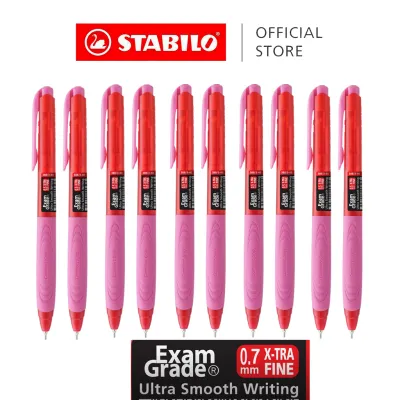
601 Lazada user ratings
Fast delivery. Have been using Stabilo 388 blue pen and love it, kid would like to try its black pen. I believe the black ones are as good.
I like this brand. Bought a bunch of different stationery. They all look good. The quality is very good too.
Suitable for both students and professionals, Smooth ink flow for effortless writing, Great quality.
good pen for primary schoolers. wish it was more discounts as it finished quite fast.
Durable and long-lasting, Comfortable grip for extended writing sessions,
Prices are valid at publication and may change. Please refer to the product page for the latest price.
When planning your layouts, higher numbers indicate broader tips that excel at structural boundaries, while lower numbers are designed for intricate details and compact writing. Keeping a quick reference guide of the millimeter equivalents in the back of your journal can help you make quick decisions when sketching out new weekly or monthly spreads.
Matching Nib Sizes to Bullet Journaling Tasks
Selecting the right pen is more effective when you match the nib size to the specific task rather than trying to use a single pen for your entire layout. Varying your line weights creates visual hierarchy that makes your pages easier to navigate at a glance.

Ultra-Fine and Fine Liners for Daily Logging
For daily rapid logging, habit trackers, and dense text, the smallest sizes like the 005 (0.20 mm) and 01 (0.25 mm) are highly practical choices. If you use a compact A5 journal with a 5mm dot grid, these ultra-fine tips allow you to write multiple lines of text within a single grid square without the letters bleeding together. They are also excellent for drawing intricate icons, tracking weather patterns in tiny boxes, or filling out detailed monthly habit grids where space is at a premium.
However, these delicate plastic nibs require a light hand. Because the metal sleeve supporting the felt tip is incredibly thin, applying excessive pressure can bend the tip or restrict ink flow. When using these sizes, perform a quick trial on a test page in the back of your journal. Rough or highly textured paper can cause these fine tips to feel scratchy or skip, so they perform best on smooth, high-quality paper.
Medium Nibs for Headings and Outlining
Mid-range sizes such as the 02 (0.30 mm), 03 (0.35 mm), and 05 (0.45 mm) serve as the workhorses of standard journaling. These sizes offer a balanced compromise between visibility and precision, making them suitable for writing daily entries if you have medium-to-large handwriting. They deliver a clear, dark line that is easily readable from a distance without overwhelming the page.
These medium tips are particularly useful for drawing the structural elements of your spreads, such as monthly calendar grids, weekly columns, and decorative banners. The ink flow is generous enough to create solid, unbroken lines along a ruler, yet controlled enough to prevent excessive ink pooling at the corners of your boxes. If you want a single pen that can handle both writing and basic layout design, a 03 or 05 is often a highly versatile option to keep on hand.
Bold and Brush Tips for Shading and Accents
When you need to create high-contrast elements, the larger standard sizes like the 08 (0.50 mm) and the Brush (BR) tip are the ideal tools. The 08 pen is excellent for bold headers, title pages, and thick outer borders that separate different sections of your layout. Because it deposits a significant amount of ink, it allows you to fill in small hand-drawn shapes or block lettering quickly without leaving visible stroke lines.
The Brush tip offers even greater flexibility, allowing you to achieve dramatic line variation simply by adjusting the angle and pressure of your hand. This makes it a popular choice for modern calligraphy, brush lettering, and adding organic decorative accents like leaves or floral doodles to your pages. Because these bold options lay down a heavy layer of pigment, they are best treated as supplementary tools for accents and titles rather than primary instruments for daily writing.
Checking Paper Compatibility and Line Consistency
The performance of any Pigma Micron pen is heavily influenced by the paper inside your bullet journal. While the archival pigment ink is formulated to resist bleeding, a broader nib like the 08 deposits more liquid onto the page, which can cause feathering or ghosting on thin paper. Conversely, ultra-fine tips like the 005 can catch on the fibers of textured or toothy paper, leading to skipping and premature wear of the delicate felt nib.
In humid environments, paper can absorb ambient moisture from the air, which slightly alters how it accepts ink. This moisture can cause fine lines to spread more than usual or increase the drying time. To ensure your layouts remain clean, always test your chosen pen sizes on a blank page at the back of your specific journal before committing to a full layout.
To maintain consistent ink flow and prolong the life of your pens, store them horizontally when not in use. Storing them vertically can cause the pigment particles to settle at the bottom of the barrel or clog the fine tip, leading to inconsistent line weights and dry writing.
Building a Practical Starter Set
You do not need to purchase the entire range of Pigma Micron sizes to build an effective bullet journaling setup. A practical starter set consists of a core trio that covers the three main functional categories: one ultra-fine pen for detailed tracking, one medium pen for daily writing and outlines, and one bold or brush pen for headers and accents. A combination of a 01, a 03 or 05, and a Brush pen provides all the versatility needed for almost any layout.
Before expanding your collection, spend a few weeks working with this basic trio to identify any genuine gaps in your workflow. If you find that your handwriting is naturally very small and the 03 feels too thick, you might consider adding a 005 or 02 to your kit. Conversely, if you prefer bold, high-contrast layouts with heavy borders, adding a 08 will help you achieve that aesthetic more efficiently.
Evaluating your personal handwriting style, the grid size of your journal, and your typical layout density will guide you toward the exact sizes that complement your planning routine, saving you from purchasing unnecessary pens that will sit unused in your pencil case.
Frequently Asked Questions (FAQ)
Do Pigma Micron pens bleed through standard bullet journal paper?
Whether these pens bleed depends primarily on the thickness and coating of your journal paper rather than the ink itself. The archival pigment ink is designed to sit on top of the paper fibers rather than soaking in, which naturally minimizes bleeding. However, broader sizes like the 08 or Brush tips deposit a larger volume of ink, which can cause ghosting or minor bleed-through on thin paper under 100 gsm.
Why does my smallest nib stop writing while the larger ones work fine?
Ultra-fine nibs like the 005 and 01 are highly delicate and can stop writing if they become clogged with microscopic paper dust scraped from the page. They are also easily damaged by heavy writing pressure, which can push the felt tip back into the protective metal sleeve. To resolve minor clogs, try scribbling gently in a circular motion on a smooth piece of scrap paper, or rotate the pen slightly in your hand to find an undamaged writing angle.
Community discussion
Share your experience or ask a question. Comments are reviewed before publication.